The influence of Édouard Glissant (b. 1928; d. 2011) has become ubiquitous in the contemporary art world, especially in the decade or so since his passing: opacity, relation, and creolization, now popular concepts, entered the art lexicon primarily through his writings. However, The Earth, the Fire, the Water, and the Winds: For a Museum of Errantry with Édouard Glissant returns to a precursory moment to focus on the Martinican poet and philosopher’s own relationship to art, not just as an art critic but also a collector with a vision for a museum.
The preposition “with” in the exhibition title seems especially instructive, underscoring how Glissant understood the artworks⎯and by extension the artists⎯he chose to surround himself with; he not only thought about them but also with (and in relation to) them. The exhibition therefore allows us to trace how his most significant philosophical interventions emerged through and from his collection. In doing so, it offers a more generous understanding of both the collector and the museum. The museum can be thought of not as “a sanctuary for certainties but rather a living, moving space,” as Mathieu Glissant, President of the Édouard Glissant Art Fund, writes in the exhibition publication. This unmooring of the institution destabilizes its authoritative and authorial power, unfixes it from both its location and identity, proposing in its stead possibilities for connection and transformation.

Installation view: The Earth, the Fire, the Water, and the Winds: For a Museum of Errantry with Édouard Glissant, Center for Art, Research and Alliances (CARA), New York, 2026. Courtesy CARA. Photo: Kris Graves.
Glissant’s collection, complied over six decades and now primarily housed at the Mémorial ACTe in Guadeloupe, is itself a map of anticolonial geographies as they intersect with histories of European modernism. The itineraries of artists such as Agustín Cárdenas (b. 1927; d. 2001), Victor Anicet (b. 1938), Eduardo Zamora (b. 1942; d. 2023), and Gerardo Chávez (b. 1937; d. 2025) challenge the narrative of modernism as distinctly European, not by seeking to expand the former to make it more “inclusive,” but rather by asserting the foundational role of Afro-Caribbean and Latin American artists in shaping the movement. What emerges is an artistic archipelago, what the artist, writer, and psychoanalyst Sylvie Séma Glissant—Glissant’s partner and the Director of the Institut du Tout-monde—refers to as “space of encounter between voices, territories, and imageries.” In other words, while Glissant’s collection maps in a certain geography, with particular spaces such as Galerie du Dragon (1955–95) in Paris emerging as key nodes, this is not exclusively a physical terrain with transnational connections. While Glissant intended his museum to travel⎯the exhibition comes to the Center for Art, Research and Alliances from Instituto Tomie Ohtake in São Paulo, Brazil⎯The Earth, the Fire, the Water, and the Winds also asserts a conceptualization of “errantry” that is equally informed by the imaginary and the internal, in much the same way as the writer understood landscape as shaped by psychic as well as material forces.

Gabriela Morawetz, Untitled, 1985. Oil on canvas, 30 × 24 ⅘ inches. Édouard Glissant personal collection. Courtesy Mémorial ACTe, fonds Région Guadeloupe.
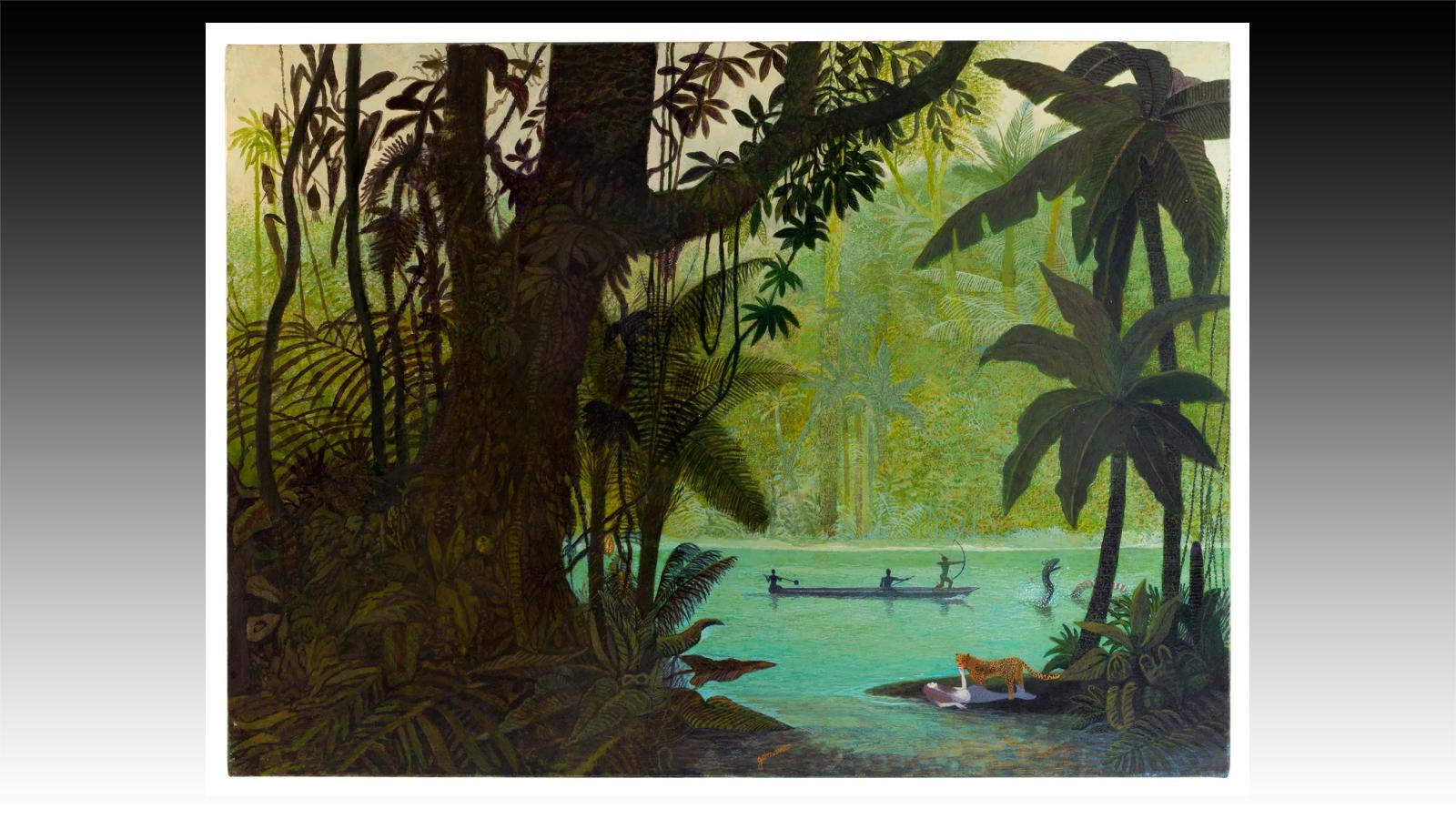
For Glissant, human relationships to landscapes are far from neutral, shaped instead by threat and suffering. José Gamarra’s paintings present a landscape that is at once seductive and beyond capture; their dense, thick quality renders them unknowable. L’inaccessible… [The Inaccessible…] (1986–87) is a lush rainforest replete with conflicting figures, drawn from multiple registers that speak to a multiplicity of histories co-existent and co-constitutive. The distinction between the figures and their environs is eroded in M. Emile’s untitled painting (no date) in which villagers surround an unrooted mapou tree, wrenched from the ground by the storm that continues to roil overhead. Here labor, ritual, political upheaval, and spirituality are not relegated to distinct spheres but instead negotiated through the landscape with no definitive resolution. The figure in Gabriela Morawetz’s untitled 1985 painting is suspended and embedded amidst a landscape that appears fluid, with indistinct plains and horizons. Her partner Pancho Quilici pursues a non-hierarchical investigation of architecture form. In his 1985 untitled collage, he creates a genre-defying typography through layering geographies and histories in relation to each other and in rejection of a single, identifiable point of origin.
Glissant considered landscape as a state, an atmosphere, rather than a physical backdrop; in Irving Petlin’s five untitled paintings (all 1990), the striking forms appear simultaneously in contrast to and as part of their surroundings. Indeed, the landscape and the figurative are not immediately distinguishable in many of the works in the museum collection. Hybrid characters appear throughout the exhibition, forms that combine human and non-human elements, seeped in the fantastical, in dialogue with Surrealism and yet not exclusively confined to it. The earth tones of Chávez’s 1978 oil painting recall cave paintings, as human figures carrying spears multiply and mutate, their shape-shifting hovering between ritual and war, between death and rebirth. The characters in Zamora’s Los Amantes 2 [The Lovers 2] (1987) fragment on the canvas as an apocalyptic drama unfolds, their disproportionate body parts coalescing into indeterminate forms.
The Earth, the Fire, the Water, and the Winds includes several works that point more directly to the collaborations Glissant was involved in, either as a subject or as an immediate interlocutor. Amongst these, Cárdenas’s charred wood sculptures, including a portrait of the poet himself, as well as the illustrations for Glissant’s 1979 collection Boises are perhaps the most striking. They underscore a worldview and practice shaped by interdependence and interconnections, by unresolved transformations. In a moment of increased skepticism about art museums and their collections, Glissant offers us a model that allows us to reimagine the art collecting beyond the rigid confines of these institutional structures.
Dina A. Ramadan is a writer and critic based in New York. She teaches at Bard College and the Center for Curatorial Studies. She is a 2023 recipient of the Creative Capital/Warhol Foundation Arts Writers Grant in the short-form writing category.
José Gamarra, L’inaccessible… (The inaccessible…), 1986–87. Oil on canvas, 30 ⅕ × 40 ⅘ inches. Édouard Glissant personal collection. Courtesy Mémorial ACTe, fonds Région Guadeloupe.
- Se connecter ou s'inscrire pour publier un commentaire
- 138 vues
18/09/2026 - 10:39
Nicolas Gary
31/08/2026 - 11:28
Gordon Henderson
16/08/2026 - 22:48