
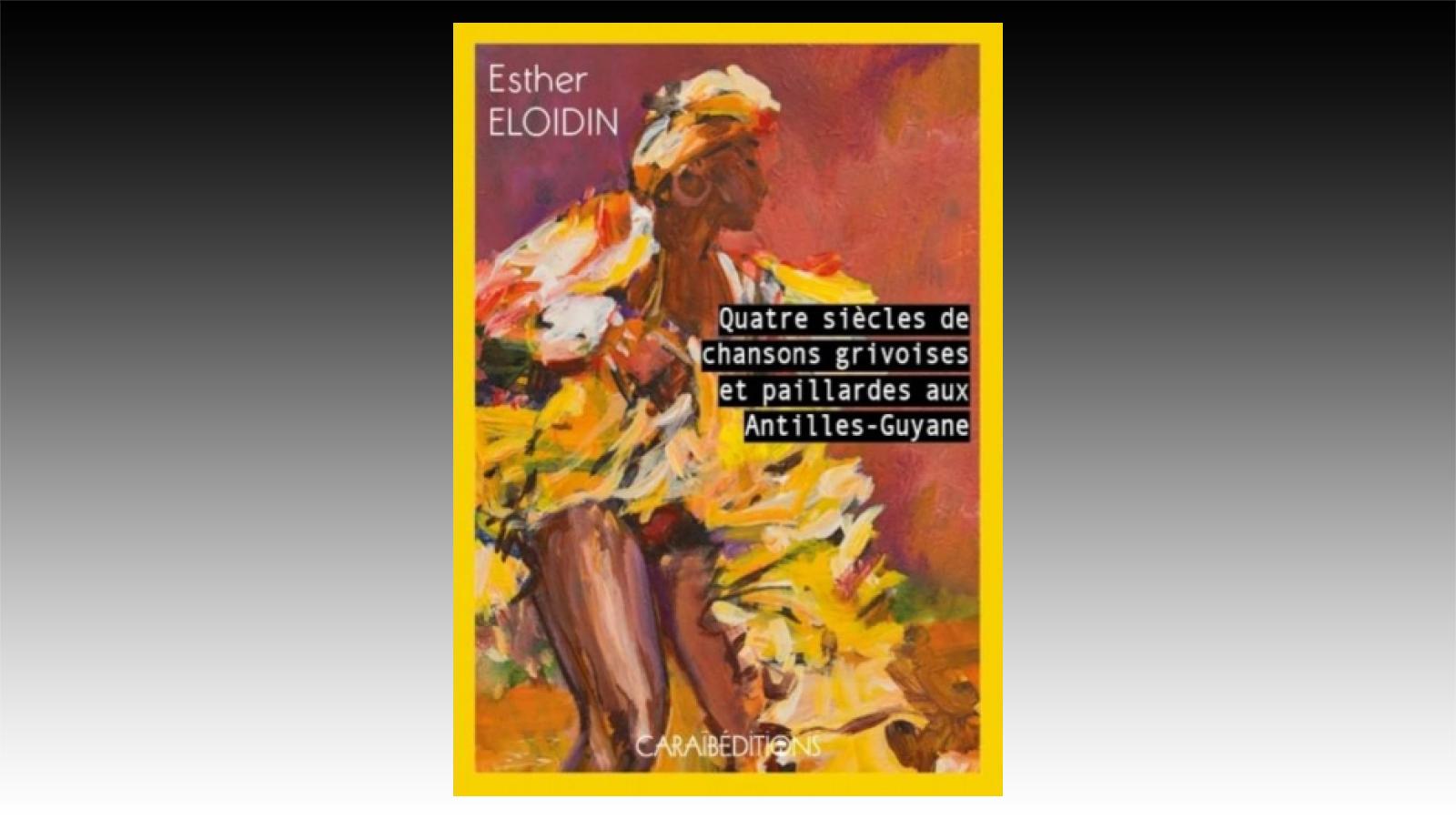
Quatre siècles de chansons grivoises et paillardes aux Antilles-Guyane is a comprehensive book that delves into the history and evolution of ribald songs over the course of four centuries in the French West Indies 18th, 19th, 20th and 21st centuries. Focusing primarily on the islands of Guadeloupe and Martinique, the book is a scholarly inquiry which traverses the realms of music, humor, and societal taboos, shedding light on the nuanced interplay between these elements. It is true that sexuality has always been ubiquitous in popular music of the F.W.I., like in many other regions of the world, however, the subject is rarely the object of academic analysis.
The author, Esther Elodin, a prominent figure in ethnomusicology and musical anthropology in the Caribbean, undertakes the comprehensive study of this often-overlooked subject. With a multifaceted background as an ethnomusicologist, stage director, novelist, and journalist. Elodin brings a unique and insightful perspective to the exploration of ribald songs. Formerly the director of an arts and performance center in the northern region of Martinique, for which she was awarded the 2005 Entrepreneurial Creation Talents Prize. She has also conducted a series of filmed interviews titled Chanté malélivé aux Antilles-Guyane, with the aim to offer a different perspective on oral musical traditions from the Antilles-Guyane region that are at risk of disappearing or often criticized, and most importantly, to contribute to their valorization and preservation. Drawing from her rich experience and commitment to cultural democratization, Elodin seeks to elevate the musical discourse of the F.W.I. with the analysis of these songs that have historically operated at the margins of academic analysis.
Elodin’s exploration is grounded in a detailed examination of the historical, social, and cultural contexts that have shaped ribald songs in the French West Indies. Through a careful curation of songs and their contextual surroundings, the book traverses themes that resonate with the region’s socio-cultural fabric, including sexuality, social and family morals, seduction, suggestive attire, hygiene, body issues, diseases, pleasure, infidelity, prostitution, magic, folklore, opportunism, menopause, colorism and more. With the help of songs by artists such as Francky Vincent, Fuckly or Jean-Pierre Coquerel, the author scrutinizes these themes across a spectrum of musical genres – ranging from traditional local nursery rhymes to Biguine, Orchestre, bèlè, gwoka, zouk, rap kreyol, dancehall, and carnival songs – Elodin’s work presents a panoramic view of the nuanced and intricate connections between music and society.
The book also unearths the subversive nature of ribald songs, highlighting their role in challenging established norms and conventions. These songs served as vehicles for artistic expression, providing a space for individuals to articulate their observations and emotions in a poetic Creole language. Because there is a fascination surrounding music with a sexual character, especially as they often face censorship and frequently shock public opinion, the hidden codes behind these songs have become synonyms of resistance and have become hymns of freedom.
Furthermore, the author discerns a dual function within some of these songs – the depiction of societal norms as well as the rebellion against them. In this dialectic, ribald songs emerge as both products of and agents for social change.
While many local songs portray freely women who aspire to more pleasure and shared desire, and men who seek to reaffirm in their hypermasculinity, other songs are stereotypical and also contain strong, aggressive misogynistic statements that promote violence and forms of sexuality prejudicial towards women. Accused of being non-conformist or having a penchant for explicit language, the implicated artists argue that these lyrics are meant to be a satirical commentary on society. Enjoying provocation, even if it means not always winning everyone’s approval, these artists have been engaged in an ongoing conflict with proponents of political correctness for many years.
While Eloidin’s work provides a wealth of insightful analyses, it is not without some structural considerations. The thematic organization in thirteen chapters, while being beneficial for in-depth exploration, occasionally leads to contextual repetition. However, this minor limitation is an inherent outcome of the thematic framework and does not overshadow the profound insights that the book offers.
Quatre siècles de chansons grivoises constitutes a significant scholarly contribution that unravels the intricate layers of ribald songs in the French West Indies. Esther Elodin’s meticulous research, combined with her deep understanding of cultural contexts and artistic expressions, showcases her commitment to preserving and valorizing this essential aspect of the region’s cultural heritage. With a particular stress on issues related to the French West Indian culture, embedded within Black culture, entertainment, resistance, hybridity, multiplicity, and interculturality, Eloidin’s book is an important contribution to the understanding and analysis of diversity constitutive of the area. By offering a comprehensive perspective on ribald songs, the book enriches our understanding of the complex interplay between music, cultural diversity and societal dynamics across centuries, establishing it as a vital resource for scholars, students, and enthusiasts alike.
- Se connecter ou s'inscrire pour publier un commentaire
- 294 vues

18/09/2026 - 10:39


Nicolas Gary
31/08/2026 - 11:28


Gordon Henderson
16/08/2026 - 22:48
Commentaires
Super !!!!!
AMINATA DIALLO
19/12/2023 - 14:33
Je vous recommande la lecture de ce texte excellent.Pour traduire utiliser Google Traduction.