[Many thanks to Holly Bynoe for bringing this item to our attention.] A fully-funded PhD studentship, to begin in October 2024, is available at the University of Warwick’s Department of History, in collaboration with the Royal Botanic Gardens, Kew, through the Midlands4Cities Doctoral Training Partnership.
Description: When breadfruit was introduced to the Caribbean in the late 18th century to feed enslaved people, it was not a success. Yet it has become embedded in the region’s cuisines. Working with the Royal Botanic Gardens, Kew, this PhD project explores how and why breadfruit was adopted and adapted to Caribbean needs – how, in short, it was creolised.
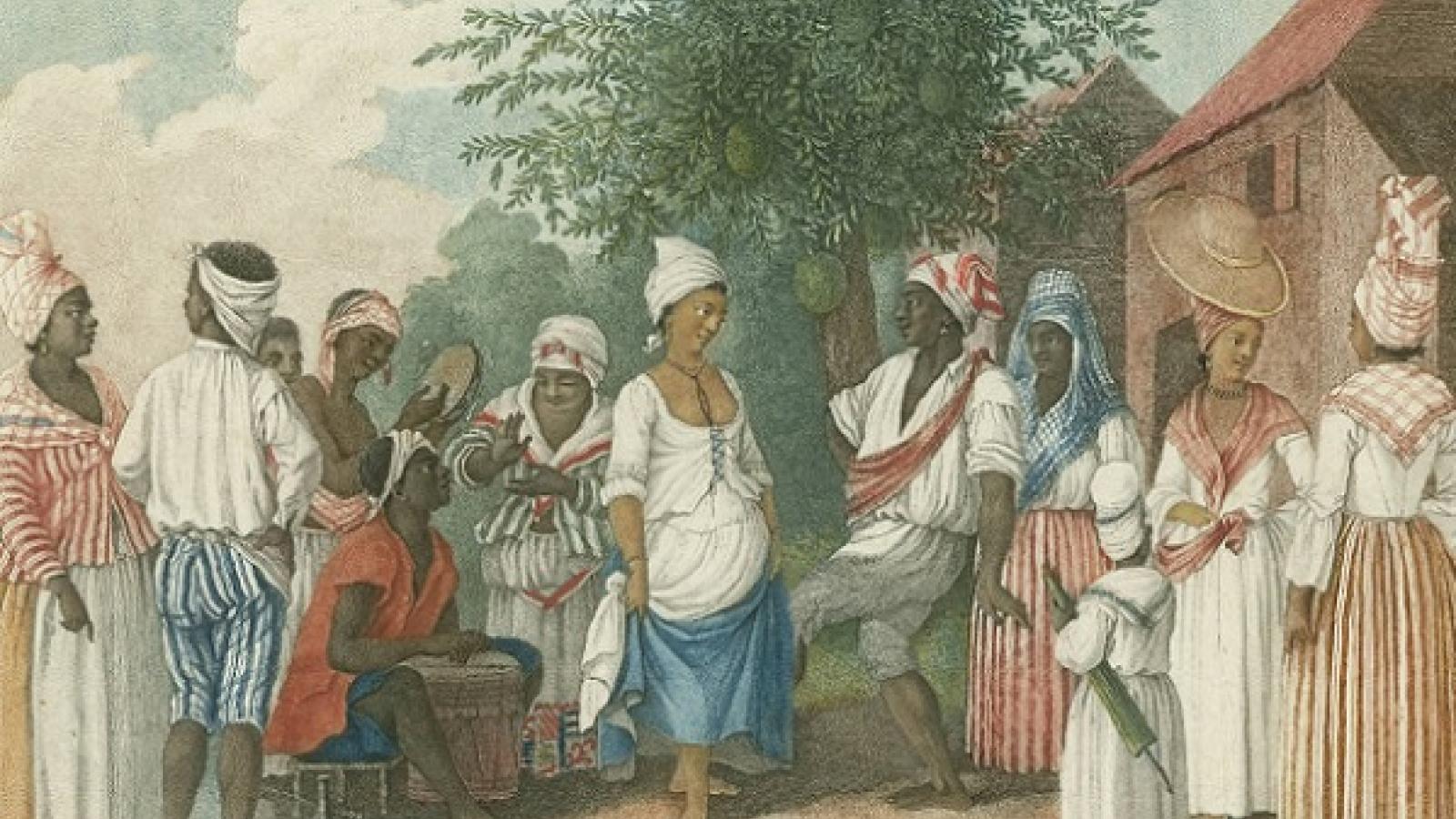
The Project: The journey of the breadfruit tree (Artocarpus altilis) from Oceania to the Caribbean in the 1790s – featuring Captain Bligh and the mutiny on the Bounty – is a well-known story encompassing global scientific networks, economic botany and an imperial project to feed enslaved populations. At first, breadfruit was not a success; enslaved people were said to reject its taste. Yet after slavery’s abolition in the British Caribbean in the 1830s, breadfruit became increasingly significant in local foodways. It is now an iconic food deeply embedded in regional cuisines. This project explores this little-known Caribbean history.
The adaption of breadfruit to local needs occurred against the backdrop of wider developments: the decline of the export-orientated plantation system; the establishment of local peasantries; efforts to modernise Caribbean agriculture; decolonisation. Other factors affecting the breadfruit’s adoption may include the presence of new populations arriving with indentureship, especially in Trinidad and British Guiana. Studying the history of breadfruit at different scales – via particular colonies, specific sites of cultivation, and different uses – reveals the routes, both elite and subaltern, through which it spread. Breadfruit now has a significant cultural presence, as an integral part of ‘national cuisines’ that emerged in the 20th century and an enduring symbol of the historical injustice of slavery. Breadfruit, in short, can tell us about the Caribbean’s past, its present, and perhaps its future.
The project provides opportunities for the successful applicant to develop their own research questions, which might include:
- How and through what means did breadfruit trees spread across the Caribbean in the 19th and 20th centuries?
- How widely and how were their fruit consumed?
- Did the breadfruit’s use as a food connect to its commercial utility as a source of fibre, timber, or adhesives?
What discourses about breadfruit circulated, and with what consequences? Why did breadfruit become of interest, at different times, to colonial authorities, scientists, post-colonial governments, international bodies, and nationalists?
The research rests on the exceptional print and manuscript collections at the Royal Botanic Gardens, Kew, whose herbarium and the Economic Botany Collection also hold many relevant specimens. Further sources are held at research centres such as the Breadfruit Institute at the National Tropical Botanic Garden, Hawaii. The project will also use other sources including botanical writing, cookbooks, travel and missionary accounts, and legal and tax records. The project is open to a range of interdisciplinary approaches, including those associated with ‘critical plant studies’, more-than-human approaches, food studies and the environmental humanities. Skill in Spanish, French, or Dutch might enable comparative approaches to the spread of breadfruit across the Caribbean.
The Studentship: The studentship covers full payment of tuition fees for 4 years (full-time) plus an annual stipend at the UKRI rate. Additional funding opportunities include a Research Development Fund (RDF) to support primary research activities, an Engagement Fund (EF) to enable students to undertake placements and other professional development activity, and a Cohort Development Fund (CDF) which supports groups of Midlands4Cities students to design training, development and research activities.
The student will be supervised by David Lambert and Rebecca Earle at the University of Warwick’s Department of History, home to over 40 academics with unrivalled expertise in topics spanning the globe, working with around 70 PhD researchers. At Kew, the student will be supervised by Caroline Cornish and Mark Nesbitt. They will be supported by Kew’s dedicated Science Education team, which oversees the 100-strong PhD cohort, organising training and academic events such as the Kew Annual PhD Symposium. They will have the opportunity to be embedded within Kew with full access to workspace, archive, library and collections, expertise across the organisation, and Kew’s global contacts.
The studentship includes opportunities to apply for funded placements of up to 6 months in total, in addition to the 3.5 years for the PhD. At Kew this could include creating an exhibition or developing community-based activities/resources. There are also opportunities for placements at a Caribbean institution such as UWI Mona or Hope Royal Botanic Gardens, Jamaica. The student will be supported in a range of other professional development opportunities, including networking, publishing, public talks and blogging.
The Applicant: Applicants should have a good undergraduate degree and a distinction-level Master’s degree (or equivalent professional experience) in history, anthropology, human geography or other relevant fields, and experience in analyzing historical sources. Familiarity with the history of the Caribbean and/or food is an advantage, as is a demonstrated ability to communicate research to a range of different audiences.
Applications should be made via the Midlands4Cities portal, which opens on 16th October 2023: https://www.midlands4cities.ac.uk/apply/
Informal enquiries may be directed to Professor David Lambert (d.lambert@warwick.ac.uk)
Source: https://warwick.ac.uk/fac/arts/history/people/staff_index/lambert/caribbeanfoodways/
- Se connecter ou s'inscrire pour publier un commentaire
- 196 vues
06/07/2026 - 15:28
Lise Brossard
15/05/2026 - 19:21